
Cao Fei, Dash: an archaeology of contemporary agriculture at Fondazione Prada

Updated: Apr 11
At Fondazione Prada, Chinese artist Cao Fei presents a new immersive and layered project that explores smart agriculture between technology, memory, and global cultural transformations.

It does not emerge as a traditional exhibition project, nor as a simple investigation into technology applied to agriculture. Dash, the new exhibition by Cao Fei at Fondazione Prada, is the result of a field research lasting over three years, conducted across the rural areas of southern and northwestern China and various territories in Southeast Asia.
The artist has closely followed the development of so-called “smart agriculture,” observing not only the introduction of drones, algorithms, and automated systems into production processes, but above all the social, cultural, and perceptual transformations these technologies generate. The project takes shape around a series of urgent questions: how does agricultural work change in the age of artificial intelligence? What happens to traditional knowledge when it is replaced, or accompanied, by data-driven systems? And how is the relationship between humans, nature, and technology being redefined?
Rather than providing answers, Dash constructs a complex environment in which these tensions remain open, moving across different languages: from video installation to virtual reality, from documentary to archival materials; transforming the exhibition space into a fully immersive experience.

A constructed landscape: The podium as an ecosystem
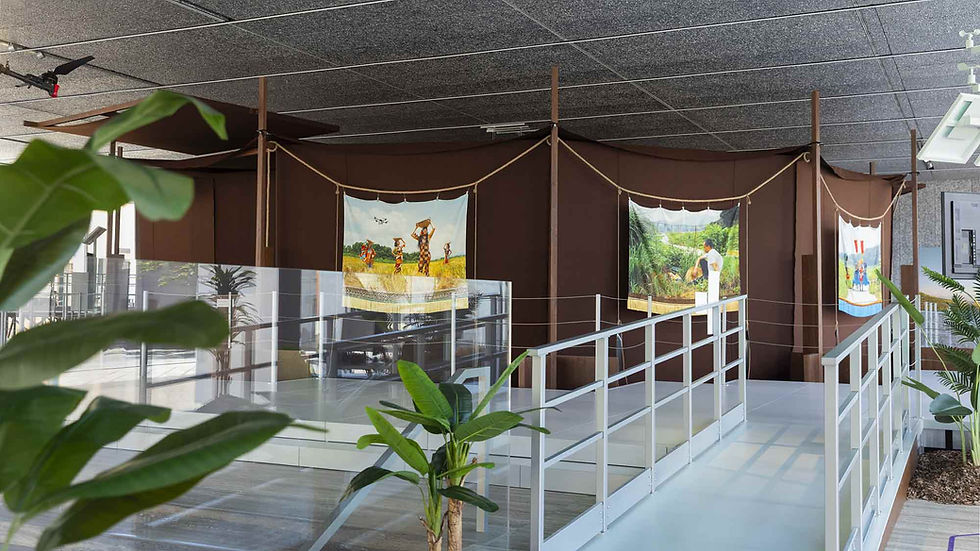
The exhibition unfolds across the ground floor and first floor of the Podium, taking shape as a layered environment in which real and symbolic elements coexist.
On the ground floor, Cao Fei constructs a landscape reminiscent of a contemporary rural village: a tent-granary, a workstation for new digital farmers, a banana plantation, and a temple. These structures, all at full scale, host videos, technological devices, and installations, creating continuity between physical space and narrative dimension.
At the center of the exhibition is Dash (2026), the two-channel film that gives the show its title. Following the agricultural cycle from sowing to harvest, the work stages the integration of human labor and automated systems, showing how drones, sensors, and algorithms gradually enter the rhythm of production.
Alongside it, The Birth (2026) reconstructs the drone production chain through an installation combining video and objects, while Dash-180c introduces an immersive virtual reality dimension: the visitor adopts the point of view of a decommissioned drone, exploring a futuristic landscape in which agriculture and technology have completely redefined the environment.


From document to archive: the exhibition as a research platform
On the first floor, the project shifts register. The environment transforms into a research platform in which historical materials, documents, and interviews expand the scope of the investigation.
Installations such as Land Evolution and Land of Plenty reconstruct the history of Chinese agriculture through photographs, educational slides, posters, and film footage spanning the period from the founding of the People’s Republic to the reforms of the 1980s. These materials show how agricultural production has been at the center of a political and ideological project, as well as an economic one.
With Super Farms and Southward Journey, Cao Fei instead documents the present: the transformations brought about by agricultural robotics, the introduction of drones in rural communities, and the redefinition of labor roles and skills.
Finally, Land Debate brings together interviews with scholars and experts, directly addressing the implications of automation: sustainability, inequality, environmental impact, and new forms of labor organization.


Between perception and automation
One of the most subtle aspects of the project concerns the transformation of perception. The introduction of intelligent technologies does not only alter physical labor, but also cognitive processes.
In their interaction with drones and remote-control systems, farmers progressively delegate certain functions, from risk assessment to spatial reading, to machines. In this way, a form of collaboration emerges in which intelligence is no longer exclusively human, but distributed.
This barely perceptible yet radical shift runs through many of the works on display and contributes to redefining the very concept of territorial experience.
Technology and ritual: new contemporary icons
It is only at this point that one of the most striking elements of Cao Fei’s research emerges.
During fieldwork, the artist observed how in some farming communities drones are integrated into traditional rituals: burning incense, offerings, and propitiatory gestures for the harvest. These practices do not disappear with the arrival of technology, but rather transform.
In works such as The Birth and Land Ceremony, this phenomenon takes visual form: drones, while highly technological tools, are elevated into symbolic objects, almost contemporary deities.
It is not a simple contrast between the ancient and the modern, but a true coexistence. Technology enters existing cultural structures, altering them while itself being reinterpreted. In this way, new forms of devotion emerge, in which technological progress takes on a value that goes beyond its practical function.

Between cosmos, human, and technics
This complexity finds a synthesis in the diagram Cosmos, Human, Technics, in which Cao Fei reworks a triad from Chinese philosophy.
The project suggests that these three elements: natural order, human action, and technology, can no longer be thought of separately. Contemporary agriculture thus becomes the site where these dimensions meet, clash, and transform one another.
Cao Fei: a research on transformation
Born in Guangzhou in 1978, Cao Fei is one of the most influential voices in international contemporary art. Her work has consistently explored the transformations of Chinese society, moving from the industrial and urban environments of her earlier works to her current focus on agriculture.
This shift is not accidental: with Dash, the artist returns to the foundations of human civilization in order to interrogate the present. Agriculture thus becomes a privileged laboratory for observing the contradictions of technology, between the promise of efficiency and the risk of cultural loss.

Beyond the narrative of progress
Dash does not propose a univocal vision of technology, nor a definitive judgment. On the contrary, it constructs a space in which efficiency and ambiguity, innovation and memory, control and uncertainty coexist.
Through a journey that combines installation, film, archive, and research, Cao Fei succeeds in conveying the complexity of contemporary agriculture as a global system.
Rather than narrating the future, the exhibition invites us to observe the present from a different perspective: as a territory in which humans, nature, and technology are no longer separate entities, but parts of a single, constantly transforming ecosystem.
Visitor information
Exhibition: Dash, Cao Fei
Location: Fondazione Prada, Milano
Dates: April 9 - September 28, 2026
Tickets: Purchase your ticket here


Comments