
Milan Design Week 2026: art that escapes design

Updated: Apr 24
During the most design-focused week of the year, some exhibitions choose to move elsewhere, between material, vision and artistic research, offering a parallel and complementary path to design.

During Milan Design Week, Milan establishes itself as an international benchmark for design. Alongside events more closely tied to the sector, however, a constellation of exhibitions and installations also emerges, moving along a parallel track.
These are projects that do not necessarily originate within the design system, or that only partially intersect with it, and which for precisely this reason offer a different perspective on the week: freer, more experimental, and often more radical.
From ceramic material that becomes architecture, to artistic practices that interrogate the body and nature, and the historical roots of twentieth-century avant-gardes, these exhibitions transform Milan into a diffuse territory of research.
Ceramics as architecture: Terrain by Hannes Peer
Among the most ambitious projects of the week, Terrain, the monumental installation by Hannes Peer for Officine Saffi Lab, redefines the role of ceramics in contemporary space.

The work presents itself as an imposing wall relief: a stratified surface in which masses of clay collide, fracture, and recombine, generating a dynamic, almost geological landscape. Ceramics cease to be decoration and become structure, an active material that constructs space.
Hannes Peer’s research openly dialogues with the Italian design tradition, from Gio Ponti to Lucio Fontana, but without any sense of nostalgia. The past is reactivated as an operative tool in what the architect defines as a “nostalgic utopia”: a tension in which memory and contemporaneity intertwine to generate new formal possibilities.

The chromatic dimension is also essential, developed through an intense material research: mineral reds, ochres, and dusty blues construct a surface that evokes desert landscapes and international craft traditions. Each module becomes a micro-landscape, marked by chemical reactions, deposits, and unpredictable variations.
The result is a work that sits between sculpture, architecture, and painting, redefining the potential of ceramics in contemporary design.
Visitor Information
Location: Via G. B. Niccolini 35a, Milan
Dates: April 20 - 26, 2026
Opening hours: 11:00 AM - 7:00 PM
Body, nature, and matter: three perspectives in dialogue
In the spaces of Palazzo Durini, MA-EC Gallery presents a three-person exhibition curated by Alisia Viola, bringing together three artists who are very different from one another, yet united by a profound exploration of the relationship between body, nature, and perception.

Aliteia – Il giardino dei fiori fuggiti dal vaso (The garden of flowers that fled the vase)
The project unfolds between painting and sculpture and originates from a performative practice, “ovarian breathing,” which transforms the body into a generative instrument. The paintings become living surfaces, marked by rhythm, error, and variation. Alongside them, the sculptures from the Impossible plants series imagine hybrid organisms, constructed through grafts between endangered species. The result is a reflection on fragility as a fertile condition and on the possibility of a beauty that emerges outside systems of control.

Avvassena – Gemellarità cosmica (Cosmic twinning)
Avvassena’s work moves between body, language, and matter. In Human Cosmogony, X-rays of different abdomens are overlaid to create collective images, where individuality dissolves into a shared dimension.
With Ante Babele, the artist imagines an original language made of indecipherable yet deeply evocative signs, while the new work Gregariousness 1. From Plank to Googol reflects on the processes of matter aggregation, from micro-elements to complex structures.
The result is a unified vision of reality, where everything is connected.

Marcello Vigoni – EGOSISTEMI#2 La Soglia dell’Acqua (EGOSISTEMI#2 The Threshold of Water)
Vigoni’s installation, accompanied by two videos, explores the relationship between control and instability through the element of water.
Water becomes a metaphor for what eludes control: it has no fixed form and cannot be definitively contained. The work thus challenges the idea of human dominance over nature, restoring a more fragile and diminished perception of our position in the world.

Visitor Information
Location: Via Santa Maria Valle 2 (Palazzo Durini | MA-EC Gallery)
Dates: April 21 - 26, 2026
Opening hours: 10:00 AM - 1:00 PM | 3:00 PM - 7:00 PM
Between Dada and Surrealism: Man Ray at Spazio Morgagni
From April 20 to 30, 2026, Spazio Morgagni presents an exhibition dedicated to Man Ray, curated by Giorgia Aprosio, creating a dialogue between works, historical context, and exhibition space.
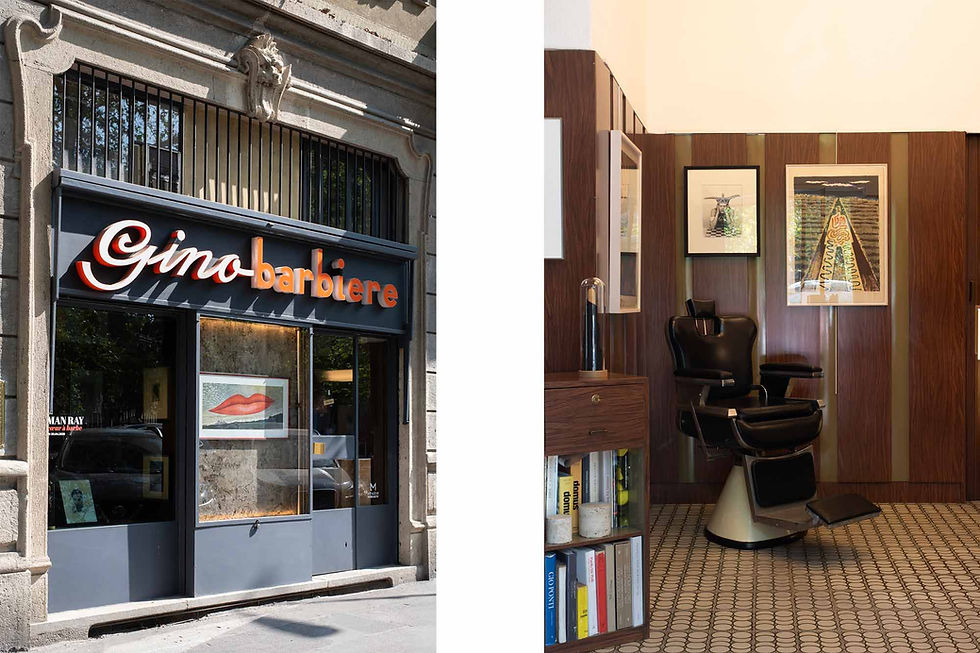
The title, Cœur à barbe, refers to the 1923 Dadaist magazine associated with Tristan Tzara and one of the most significant moments in the rupture between Dada and Surrealism. This tension also runs through the figure of Man Ray, who constantly balanced belonging and independence.
The exhibition already opens in the display window of the former barber shop that hosts the space, featuring iconic works such as Cadeau and Autoportrait avec moitié barbe, creating an initial disruption between art and the urban context. Inside, the exhibition unfolds through photographs, lithographs, films, and artist’s books, including the celebrated short film Le Retour à la raison (1923), made without a camera through the technique of rayography.
Particular attention is devoted to the female figure, a central theme in Man Ray’s practice, present in various photographic works and publications on view.

Visitor Information
Location: Via Giovanni Battista Morgagni 2 (Spazio Morgagni)
Dates: 20 - 30 aprile 2026
A look beyond design
These three projects, while very different from one another, highlight a fundamental dimension of Milan Design Week: one in which design opens up and allows itself to be traversed by other languages.
It is in this hybrid space, between art, architecture, and experimentation, that some of the most interesting research on the contemporary scene emerges. And perhaps it is precisely here, at the margins of design, that the most free-ranging perspectives can be found.


Comments