
Fondazione Prada presents a new permanent installation by Alex Da Corte.

With Housepainter II, the American artist becomes part of Fondazione Prada’s permanent Atlas project. Alongside Mouse Museum (Van Gogh Ear), a house painter dressed in pink and a collection of pop objects challenge the relationship between identity, memory, and exhibition space.
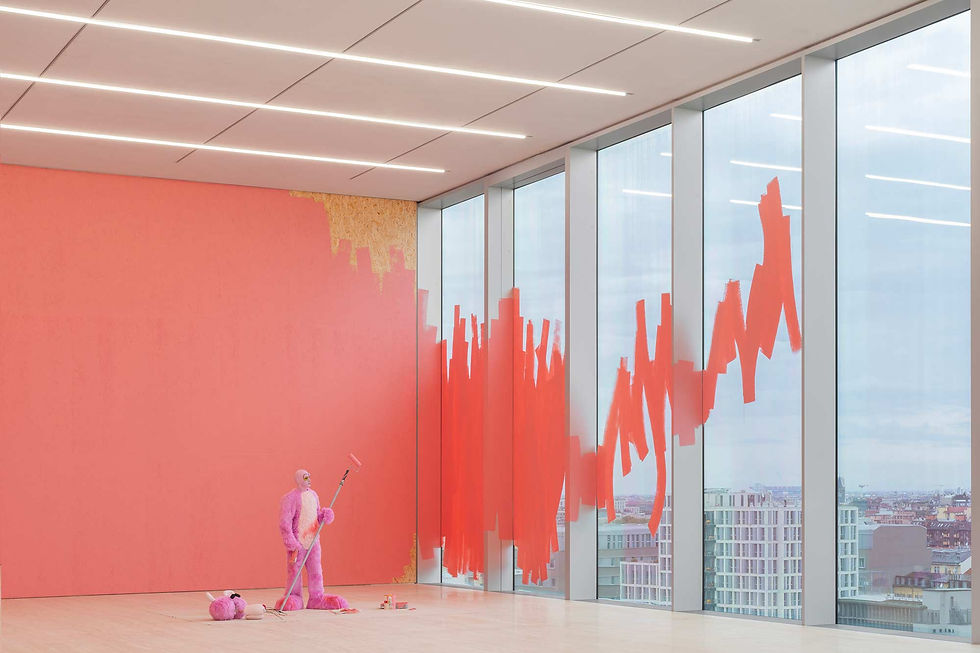
What happens when a cartoon character enters a museum and starts repainting its walls? With Housepainter II (2025), Alex Da Corte transforms an everyday gesture into an action that questions the meaning of self-representation, the power of popular imagery, and the way artworks inhabit exhibition spaces. From October 28, 2026, the installation becomes part of Atlas, Fondazione Prada’s permanent project in Milan, where it is presented alongside another work by the American artist, Mouse Museum (Van Gogh Ear) (2022).
The dialogue between the two works offers a way into Da Corte’s world through two seemingly opposing approaches: on the one hand, the collection and preservation of objects as tools for reconstructing personal memory; on the other, an action that expands into space, gradually transforming its appearance. In both cases, identity is not something stable to be represented, but a construction in constant motion, shaped by images, memories, desires, and cultural references.
Housepainter II: the Pink Panther at work
At the heart of Housepainter II is an immediately recognisable figure: the Pink Panther. This iconic character from popular culture becomes the artist’s avatar, taking on the role of a house painter tasked with painting the walls of the exhibition space. A roller, a bucket, and a protective sheet are the tools of an intervention that begins with an ordinary activity, transforming it into a reflection on labour, self-representation, and the possibility of altering one’s surroundings through a repeated gesture.
The choice of the Pink Panther is more than an ironic device. In Da Corte’s practice, pop culture characters and everyday objects become tools for examining society and its contradictions. The artist draws on both popular imagery and art history, bringing seemingly distant references together and challenging the hierarchy between high culture and mass culture.
The Pink Panther, with its instantly recognisable visual identity, thus offers the artist a figure through which to represent himself without resorting to his own face. Self-representation takes place through an existing character, a cultural mask that makes it possible to explore the relationship between the individual and their public image. Who are we, after all, if not also the sum of the figures, symbols, and stories through which we learn to recognise ourselves?


In Housepainter II, however, the character does not simply occupy the scene: it acts upon the space. Painting becomes a process of transformation, a gesture that leaves a trace and suggests the possibility of intervening in the surrounding world without necessarily reaching a definitive conclusion.
Da Corte himself describes the work as an installation designed to expand, capable of transforming its surroundings and reaching ever further outwards. The house painter, having paused in the midst of a seemingly endless task, wonders how much work remains to be done and to what extent his actions might colour an boundless landscape. It is precisely this disproportion between the concrete gesture and the vastness of its potential outcome that gives the installation a dimension that is both humorous and unsettling.
Painting a wall thus becomes more than changing the colour of a surface: it is an attempt to leave a mark, to temporarily take possession of a place, and to redefine one’s relationship with the surrounding environment.
Mouse Museum (Van Gogh Ear): objects as self-portrait
While Housepainter II explores identity through action, Mouse Museum (Van Gogh Ear) takes the opposite approach, turning inwards. Created in 2022 for the exhibition Mr. Remember at the Louisiana Museum of Modern Art in Denmark, the work pays homage to Claes Oldenburg’s Mouse Museum, reinterpreting its structure with an irony that borders on the grotesque.
Oldenburg had transformed a collection of industrial objects into a miniature museum, giving ordinary items exhibition value and turning them into records of material culture. Da Corte takes up the structure inspired by Mickey Mouse’s head, also recognisable in its camera-like contours, but intervenes in a provocative way: the museum features a missing ear, a reference to the episode involving Vincent van Gogh, an emblematic figure in an artistic imaginary where life, suffering, and myth intertwine.


Inside, a long display case holds hundreds of objects from popular culture belonging to the artist’s personal collection. These are things that have been collected, preserved, and brought into relation with one another: fragments of a private universe that, through their display, become elements of an indirect self-portrait.
It is not the artist’s face that tells the story of his identity, but the constellation of objects he has chosen to hold on to. Each item carries its own associations, memories, and desires; together, the objects form a kind of emotional archive in which the personal intertwines with a shared repertoire of images and symbols.
Da Corte describes the Mouse Museum as a mausoleum, a repository of found and created things, collected and presented as if in a waking dream. This is a significant image, as it captures the work’s dual nature: a place of preservation, but also a space in which objects lose their original function and acquire new meanings. The museum does not simply preserve things; it removes them from everyday life and transforms them into tools for understanding.
Two ways of hinabiting space
The joint presentation of Housepainter II and Mouse Museum (Van Gogh Ear) reveals a tension that runs through both works: the need to contain the world and, at the same time, to go beyond its boundaries.
On the one hand, there is a closed, introspective structure that gathers objects and organises them into a kind of personal archive. On the other, a pink field that expands through the act of painting, transforming the environment and opening outwards. The first work preserves, selects, and catalogues; the second acts, transforms, and occupies.
Da Corte himself emphasises this contrast, describing the museum as a black monolith, grounded and capable of absorbing light, while the house painter gives shape to a sunlit pink field that extends into the surrounding world. These two opposing yet complementary images suggest two different ways of relating to reality: gathering what defines us or intervening in what surrounds us.

The difference also lies in the way the public encounters the works. In Mouse Museum, the viewer’s gaze lingers on the objects, their differences, and the relationships that emerge within the display case. In Housepainter II, by contrast, attention shifts towards an action and the consequences it produces in the space. It is not simply a matter of observing a work of art, but of engaging with an environment conceived as something that can be modified, open to transformation.
Both installations thus challenge the idea of the museum as a neutral container, a space that simply houses completed works. Here, the exhibition environment becomes an integral part of the work: it can be an archive, a landscape, a surface to be altered, or a place where memory takes shape.
Atlas, a map in constant evolution
Atlas is Fondazione Prada’s exhibition project, conceived as a mapping of the ideas and visions that have shaped the institution’s activities from 1993 to the present. Through juxtapositions of artists and works from different periods and artistic languages, the exhibition creates an open dialogue, destined to evolve over time with the addition of new works and perspectives.
In this context, Alex Da Corte’s practice forms part of a broader reflection on the ability of contemporary art to reinterpret images and objects from popular culture. Balancing irony and estrangement, his works explore themes such as identity, memory, and the relationship between the individual and their environment, showing how even what seems familiar can become a means of questioning the way we look at the world.

Comments