
In conversation: curator Alisia Viola
Updated: Feb 5
Curating today means listening to the present moment, moving across languages, and designing experiences. In this conversation, curator Alisia Viola discusses her approach, spanning critical research, new technologies, and the construction of shared visions.
Curated by Simon Invernizzi

It’s a cold January morning, the air biting, hands seeking refuge in pockets, yet the sun, high above the wide square of Fabbrica del Vapore, manages to warm just enough to make you want to explore every corner of the place.
I slowly make my way through the open space. Ahead of me, several posters display the name of the person I’m about to meet, almost forming a small visual path that leads me to the café. As I enter, I see her immediately: seated near the window, laptop open, her focused gaze instantly melting into a warm smile when she notices me.
Alisia Viola (Milan, 1995) is an art curator, critic, and cultural project manager. She develops and directs contemporary art projects in collaboration with museums, institutions, and galleries in Italy and abroad. Her research focuses on new practices and emerging artistic languages. She also teaches at several educational institutions, including the Italian Design Institute.
I discover, much to my disappointment and growing hunger, that they don’t have vegan brioches, so I settle instead for some water and something savory, after all it’s almost eleven, I can allow myself that.
The atmosphere of the café is typical of the Fabbrica del Vapore: industrial, straightforward, with that patina of memory that only revitalized spaces can possess. Once a workshop of Carminati & Toselli, today this space is a cultural hub, a crossroads of languages, ideas, and energies, and it’s no coincidence that we are meeting here.
I sit down across from Alisia, while through the window behind her I catch sight once again of the poster announcing Artificial Beauty by Andrea Crespi, the project currently on view at the Fabbrica del Vapore, curated by Alisia Viola and Sandie Zanini, and co-produced by the museum and the City of Milan.
Alisia gently closes her laptop, looks at me with a genuine attentiveness, a rare kind, rooted in listening and we begin to talk.

How are you, Alisia? And how is Artificial Beauty going? I know it represents an important milestone for both you and Crespi: it’s the first major institutional exhibition for each of you. What has it meant to work on a project of this scale?
Hello Simon, it’s a pleasure to meet you. I’m going through a very fertile and serene period in my life, and I think this also reflects in the way I approach projects. Artificial Beauty is now in its final month and is undoubtedly the most complex and layered curatorial project I’ve undertaken so far. We’re very happy with how it’s going, and above all, seeing the curious gazes, the reactions, and the questions from the audience is perhaps the most precious part of all this work.
For me, the true measure of a project is being able to engage with its own time, to build a meaning that is not only theoretical, but also emotional and experiential. Andrea and I have been working together for five years; we’ve grown together, and reaching this milestone together carries a significance that goes beyond the individual exhibition. It was a project that taught us what it truly means to build: first a team, then a shared vision, and finally a real space in which that vision could take shape.
It has been an intense year, during which we worked to create an exhibition that wasn’t simply a sequence of works, but an experience, a journey. Something that didn’t just show, but asked the audience to inhabit the questions that our time presents to us.
I know you’ve worked at Fabbrica del Vapore several times. What does this place represent for you within Milan’s cultural landscape? And what does it give back to you each time you return?
Yes, I’ve curated several projects at Fabbrica del Vapore, and I can say that by now it has become a kind of home for me. When I think of this space within Milan’s cultural landscape, I see a place that connects, that allows for contamination, and that in turn generates new exchanges: an institution dedicated to contemporary arts capable of hosting and navigating very different languages. Every time I come back, I feel like I’m re-entering a living organism that changes along with the projects it hosts.
It’s a space that, while deeply tied to its history, compels you to think site-specifically, to engage in dialogue with the architecture, with the interplay of voids and solids, with distances and proportions. For me, it’s a place that always offers a challenge, but also a great sense of freedom. And every time I work here, I feel that I’m not simply presenting an exhibition or a project, but leaving a trace within something that will continue to live on long after we’re gone.


When you approach a new project, what is the first curatorial gesture you make?
Where do you start: with the artist, the space, the theme, or an urgency?
I believe the first curatorial gesture is never a visible one. It is an act of listening. Even before thinking about the works or the dialogue with the context, I try to understand what kind of question is asking to be posed. Every project, if necessary, is born from an urgency of the time we are living through. Sometimes this urgency takes the form of an artist, sometimes of a space, sometimes it is a theoretical friction, a fragile intuition that I don’t yet know how to name. I don’t believe in a fixed starting point, but I do deeply believe in listening, dialogue, and exchange.
My work begins when I feel that among different elements, be it a place, a research or a work, a magnetic field emerges that needs to be inhabited. Only after that does the actual construction begin: selecting, subtracting, assembling, choreographing. For me, curating means caring in the truest sense of the word; creating the conditions for something to happen. Ultimately, every exhibition is an attempt to make visible a world that we do not yet fully know how to articulate.
Your work combines critical thinking, project management, and creative direction. How do these three dimensions coexist when you’re putting together an exhibition or cultural project? Does one ever take precedence over the others?
I don’t think of them as three separate functions, but as three layers of the same responsibility. The critical dimension is what gives a project its depth, its invisible structure; creative direction is the way that thought takes shape and becomes experience, space, and rhythm; project management is what allows all of this to truly exist, to take form in the real world.
If one of these dimensions takes precedence over the others, the project becomes unbalanced and risks turning into a purely theoretical exercise, an empty aesthetic gesture, or an efficient operation devoid of soul. My work lies precisely in holding these three forces together in a constant, productive balance.
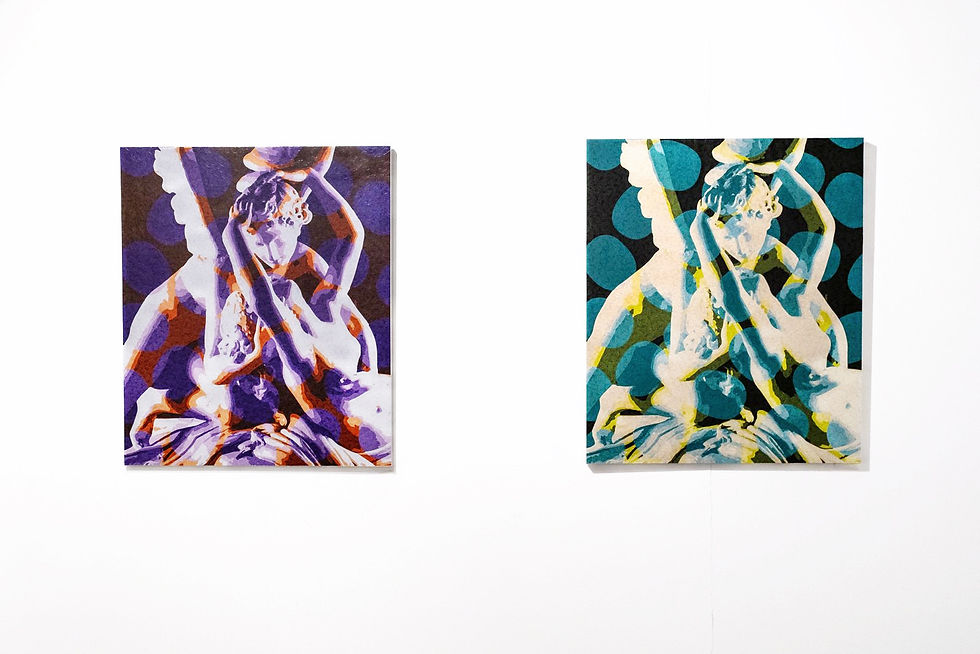
Your critical research focuses strongly on emerging languages. In your view, which practices today are redefining the vocabulary of contemporary art? And what attracts you most about these areas of experimentation?
Today, fortunately, we are living in a moment when what is first observed and questioned is not so much the language or technique an artist adopts, but the thinking behind it and what they truly want to express. I believe it is essential to be aware of what one wants to communicate to the world and to find a form that can resonate with an authentic necessity. Practices are multiple and, in a certain sense, increasingly less distinguishable from one another.
On the one hand, painting continues to be the universal language of art, constantly renewing itself; on the other, the integration of digital media is clearly helping to redefine the field of contemporary art. Artificial intelligence has become, for many, a kind of contemporary brush and an extension of the creative process. Personally, I am always drawn to what I do not yet know, to those languages that may not even be fully born yet. I am increasingly interested in working within hybrid zones between different techniques and forms of expression, where things are not yet completely defined.
What is the most useful mistake you’ve made in your journey? Not the one you’d rather forget, but the one that, over time, changed the way you look at your work?
Thank you for this question, I find it truly beautiful and very constructive. I’m usually asked what my most ambitious project has been or what the best part of my work is. In reality, I believe that more than anything else, it is our mistakes that shape us: making mistakes and failing are what truly allow us to grow and improve day by day.
The most useful mistake for me was not fighting hard enough for what I wanted, putting myself aside and, as a result, missing some opportunities early on that would have been important for my work. I’m a rather perfectionist person and therefore very self-critical, and these traits influenced my way of moving forward for a long time. Not getting what I wanted made me realize that I needed to change my method and develop a strategy, to clarify my direction and take more risks. As I’ve grown, I’ve understood many things, and developed a number of new awarenesses that certainly support me in my professional path today.

You teach Applied New Technologies for the Arts and often work on hybrid projects. What role does digital culture play in curatorial practice today? And what does the art system still need to learn from this world?
I would start from the idea that digital culture is a biological extension of our lives. As a result, in my field too it is used in this sense, amplifying projects, experiences, and audiences. Today, the digital is no longer just a tool; It has become part of the mental, cultural, and perceptual environment we already inhabit. For this reason, in curatorial practice I don’t consider it a separate language, but rather a force that has already reshaped how we produce images, construct narratives, and organize the time and space of experience.
What truly interests me is understanding how it is already changing the way art is created and experienced, from the making of the works to the construction of an exhibition display. In my view, the art system still needs to learn to recognize it as an infrastructure. As long as we continue to see it as a category, it will remain something separate.
The real challenge is accepting that it has already transformed our lives, our way of creating, and our way of thinking. In my view, it no longer makes sense to separate the physical from the digital, because we are fully living in the digital age, and it is important to embrace and critically understand everything positive and intelligent these tools can offer us. Today, curating also means being able to work within systems that never stop updating and that, for this very reason, can no longer be considered fixed or definitive.
After Artificial Beauty, will we see more of your projects in the city? Are there any projects or aspirations that you feel are ready to emerge?
Yes, in the coming months there will be new projects, both in the city and beyond Milan. For me, however, this is primarily a period of sedimentation, a time when I am focusing more on writing, research, and the genesis of ideas, which never fail to emerge and grow. Some paths have already begun, while others are still seeking their ground and will gradually take shape over the next few months. Ultimately, I continue to believe that a dream stops being just a desire the very moment you begin to work on it seriously. Just before you arrived, I was writing something that still resembles a dream. We’ll see if it has the courage to become a project.


Comments