
If the magnolia could speak
Updated: Oct 1
MAGNOLIA at the Accademia di Belle Arti di Brera: eighteen graduating artists return to the place where they trained.
Curated by: Cecilia Severini

A great curtain of magnolia leaves opens before me. It clears the way and opens the gaze toward a continuous process of losing and finding oneself, within a space that, for generations of students, has represented much more than simply a place of passage.
On the occasion of the 250th anniversary of the Accademia di Brera, from September 15 to October 3, 2026, MAGNOLIA is presented as the concluding event of the Grande Brera celebrations. Curated by Massimo Kaufmann, with a critical text by Lorenzo Madaro and an intervention by Marco Cingolani, the exhibition brings together eighteen artists who graduated from the Accademia di Belle Arti di Brera, invited to return, through their works, to the place that accompanied a fundamental part of their training: the former church of San Carpoforo.
Eighteen gestures, eighteen traces, eighteen different imprints, united by the same experience: having grown up in the shade of the magnolia and, at the same time, having contributed to its growth through their own experiences, conversations, experiments, and reflections. It is not merely a place to rest between one lesson and the next, but a space for growth, planning, and dreaming.
Under that magnolia, ideas still waiting to be developed, freshly sketched projects, ambitions, and possibilities have come together. Some, like me even today, have dreamed with their eyes open while sitting beneath its branches, rolling up their sleeves and trying to give shape, little by little, to what did not yet exist. Perhaps this is precisely where the magnolia becomes a living archive: it not only preserves the memories of those who have passed through, but continues to welcome those of people who, even today, beneath its leaves, imagine their future.
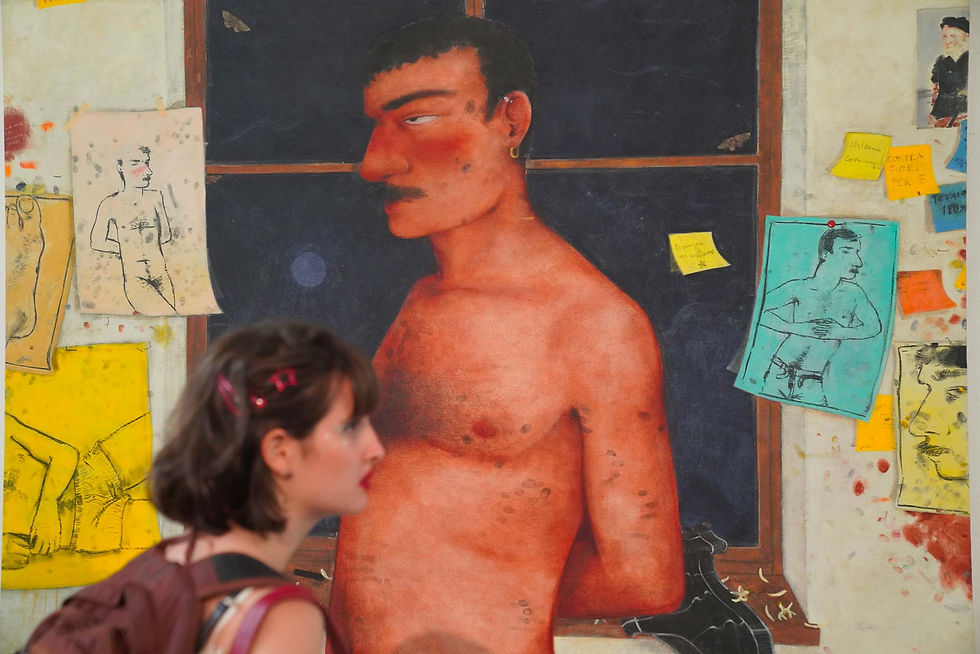
It is precisely Roberto De Pinto who creates the passage between the threshold of the former church and what those students have created beneath that tree. With Disegnare la Magnolia (Drawing the Magnolia) and his unmistakable canvases populated by male bodies, the artist presents a living form of painting, made of skin, sensuality, and Mediterranean intimacy. Nature and the body intertwine in a ritual of care and identity research, where magnolia leaves become an extension of touch and desire. De Pinto thus establishes a first, powerful point of anchorage, introducing a journey that invites the viewer to get lost, find themselves, and then get lost and find themselves once again.
Losing oneself, first of all, in the imagery of Aronne Pleuteri, where painting explodes in a short circuit of primordial, instinctive, and unpredictable forms. His gesture, saturated with a powerful ironic and expressive charge, abandons all formal rigor to make room for patches and presences of pure color: a free dimension that places us in a condition where composure and predictability are entirely excluded from our gaze.
Even in the works of Denise Ceragioli, color plays an important role: fluid and freed from defined contours, it moves freely and autonomously. Yet it is not the true protagonist. That role belongs to matter: wax, an unpredictable and autonomous material, endowed with a shifting and uncontrollable identity. The material emerges, blossoming from the canvas; then it withdraws, making room for the color beneath; then it emerges once again, and so on, in a continuous swarm of undefined forms.
The fluidity of matter also finds its way into the work of Claudia Mangone. Matter is shaped until it finds its completeness in an intimate and delicate, yet at the same time powerful and angular, geometrization. On the wall, the work almost seems to drip, revealing the nature of a light and slippery subject: a play of opacity and transparency that deceives the eye and destabilizes its certainties. This disorientation continues in the instability of Martina Franchini’s sculptures: an invitation to surrender to precariousness without fear, anxiety, or unease. It is in imbalance that everything finds its place once again; it is in disharmony that the composition resonates according to its own profound orchestral cadence.
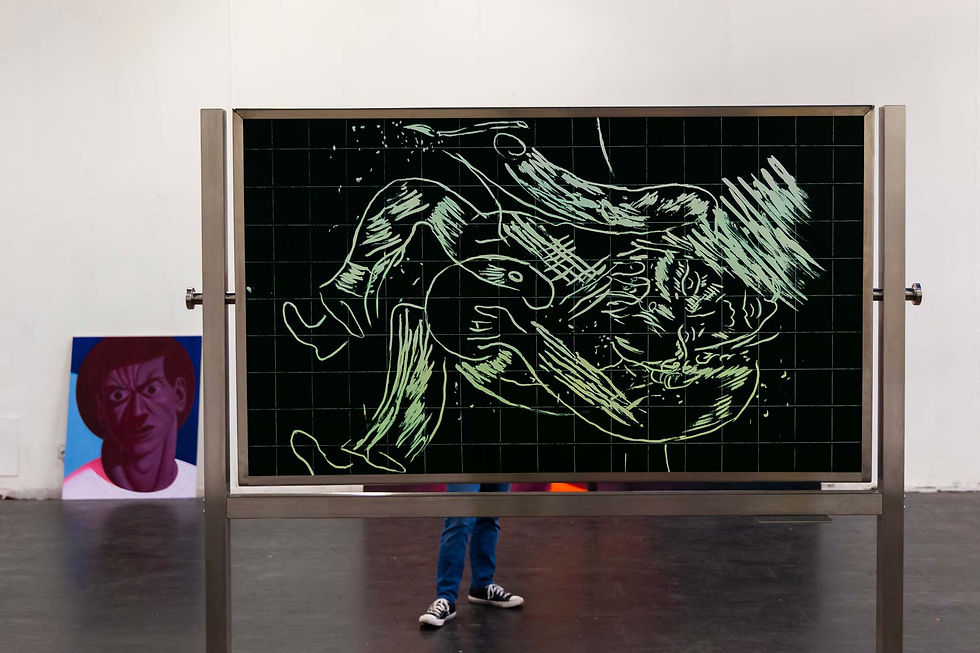
A rhythmic and immediate tension also characterizes the work of Matteo Capriotti. Through an energetic gesture, the artist reminds us of something familiar that, at the same time, unsettles us. The familiarity and ease we share with the blackboard, an object that feels congenial to us all, disappear the moment we begin to lose ourselves in the tension of a rapid gesture, almost like a note, evoking not only a dimension of ironic childhood, but also the archaic nature of the trace.
With a different approach, Gabriele Napoli presents contours that, while retaining a distinct presence thanks to the weight and solidity of chalk, ultimately dissolve, blending into one another in a continuous interpenetration of matter and pigment. At the boundary between reality, fantasy, and memory, his works appear as dreams steeped in mystery and unspoken things. The viewer’s eye becomes lost, oscillating between the darkness and ambiguity of a space that is at once urban and natural, in a perfect balance between the disturbance of the unknown and the reassurance of the familiar.
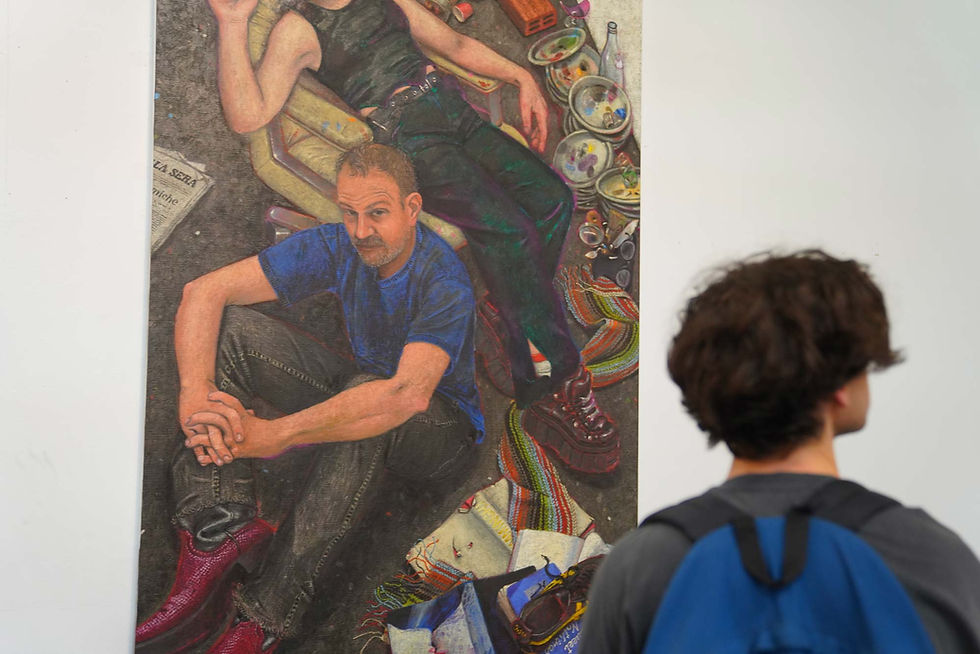
If disorientation erases visual references, the dimension of finding oneself again instead moves through recognition. This is the case with the works of Emilio Gola, which speak to each of us: of our objects, the clothes we wear, our hairstyles. His compositions confront us with scenes observed sometimes frontally, sometimes from above, as though through the lens of a camera. A question naturally arises: are we the ones looking at the figure, or is the figure, with a subtle hint of defiance, looking at us?
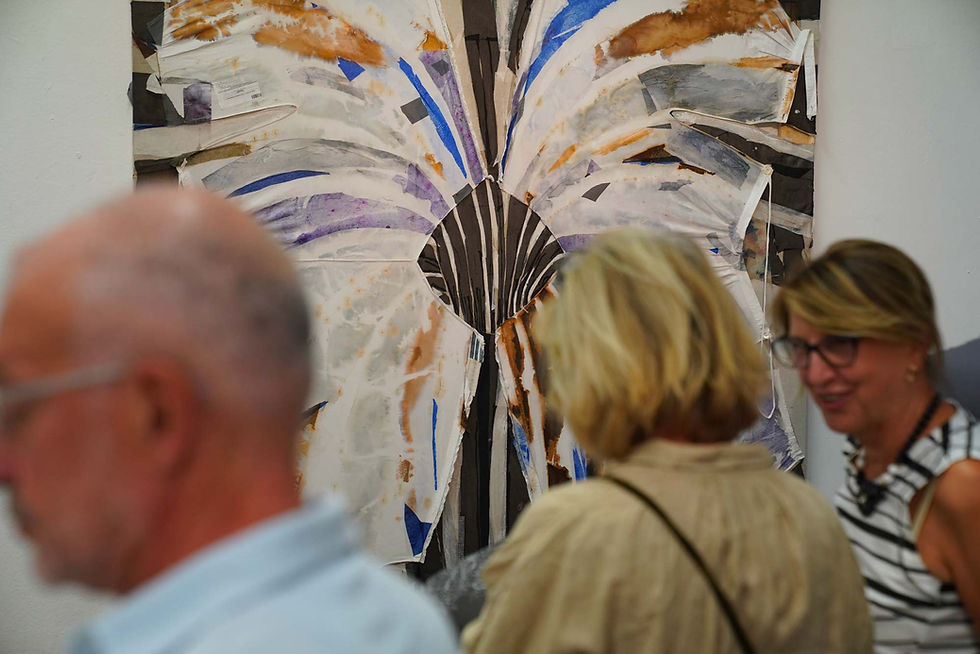
This same dimension of intimate everyday life and family memory can be found, through a different language, in the work of Ermanno Brosio. Through a skilful process of hand-cutting and sewing, his works take shape from assemblages of fabrics taken from old clothes, whose textiles blossom harmoniously across the canvas. Although they have lost their original function, these elements continue to speak of all of us, preserving traces of lived stories that could easily be our own.
If in Brosio memory relies on matter and touch, with Martina Cassatella the intimate dimension becomes intangible. The artist does not present us with an explicit energy, but suggests it. She evokes the force of a warm light, the origin and end of all things, focusing attention on the hands: hands that will never capture this glow, which passes through them with every opening, with no other possibility. With this work, the artist celebrates a universal human gesture, bringing to life in each of us an intimately shared emotion.
From the poetry of this single gesture, the journey of finding oneself again expands into the evocation of an entire visual heritage rooted in collective memory. This is where the work of Francesco Marcone comes in, drawing from this shared archive to present scenes that are dear and familiar to us all, constructed as true historical paintings reinhabited by the contemporary. Yet this visual immediacy is followed by a subtle sense of disorientation: with a touch of irony, the artist places us before a theatrical provocation in which time becomes univocal and history seems to have suddenly come to a standstill.
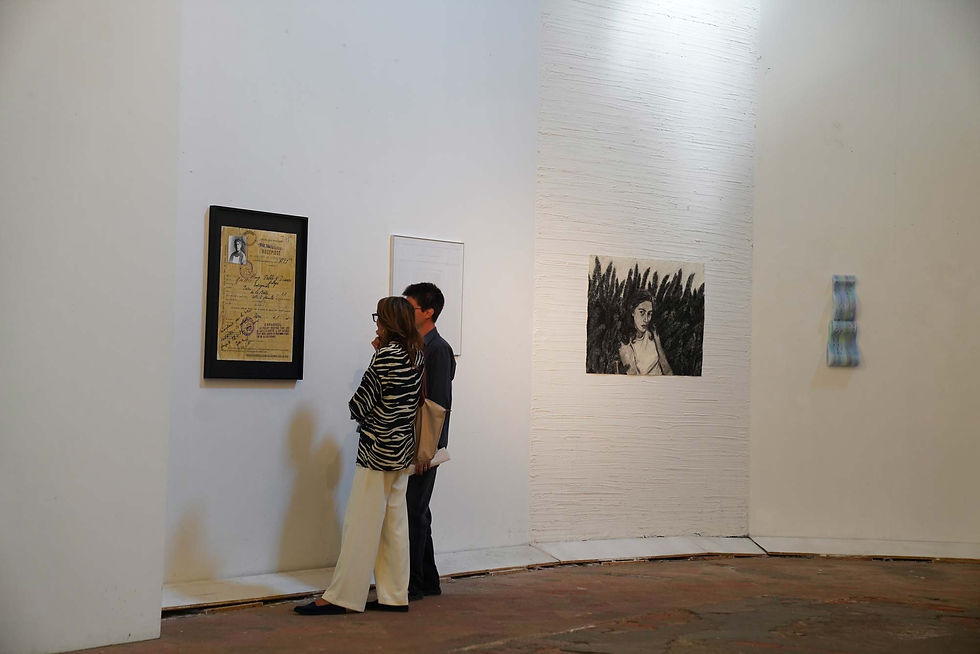
Marcone is not the only one to draw on this repertoire of collective images. Nicolò Villa, in fact, reproduces official documents, passports, and identity cards with millimetric precision, elevating them to the status of true portraits. Through this refined visual deception, the artist teaches us to pay attention to and care for everyday objects created for purely functional and momentary use, revealing the identity-bearing quality of elements that the rush of everyday life usually leads us to overlook.
This same impulse to reactivate memory and inhabit the archive resonates in the audio work of Cecilia Mentasti. The artist constructs an intimate and emotional narrative by telling one hundred dogs the stories of one hundred Italian artists of the twentieth century. Stripping art history of any historiographical pretension, her research restores a profound affective dimension to stories of the past, offering a space for listening and welcome that becomes, in every sense, an ideal and shared “place to be.”
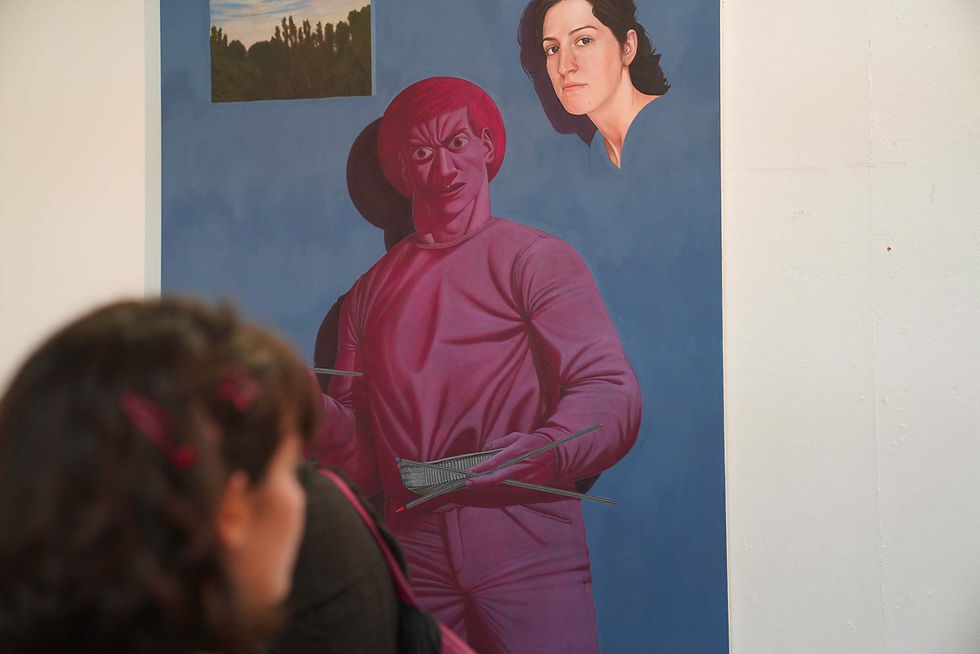
The reflection on memory and identity continues along a different trajectory in the work of Andrea Loi, who, unlike the artists mentioned above, chooses to conceal his own identity, challenging the classical painting tradition associated with portraiture and self-portraiture. Male figures are a constant presence in his works: characters who stare at the viewer with an air of provocative defiance, maintaining a rigidity and solemn composure in every situation.
Finally, the exhibition reminds us that finding ourselves again also means rediscovering the patience and dedication required to observe. Pausing to investigate, to scrutinize, without the rush to exhaust a visual and aesthetic experience out of anxiety to move on to the next one. Simply stopping. This is what Stefano De Paolis and Massimo Pugliese lead us to do, in two distinct ways. If De Paolis works with an almost imperceptible contrast, relying on the intangible whiteness of the surface, Pugliese seeks a more pronounced chiaroscuro, where light emerges from darkness.
Through drawing, De Paolis invites us to care, to calmness, and to attentiveness. His mark whispers, with meticulous and painstaking precision, something elusive that reveals itself to the eye only after a few seconds of contemplation, leading us to reflect on the work also as a purely physical experience. In the works of Massimo Pugliese, the artwork requires time, but also calls for gentleness and patience. Man silently reunites with nature, and the two of them shine together within the darkness of the setting, until they become lost in and merge with one another.
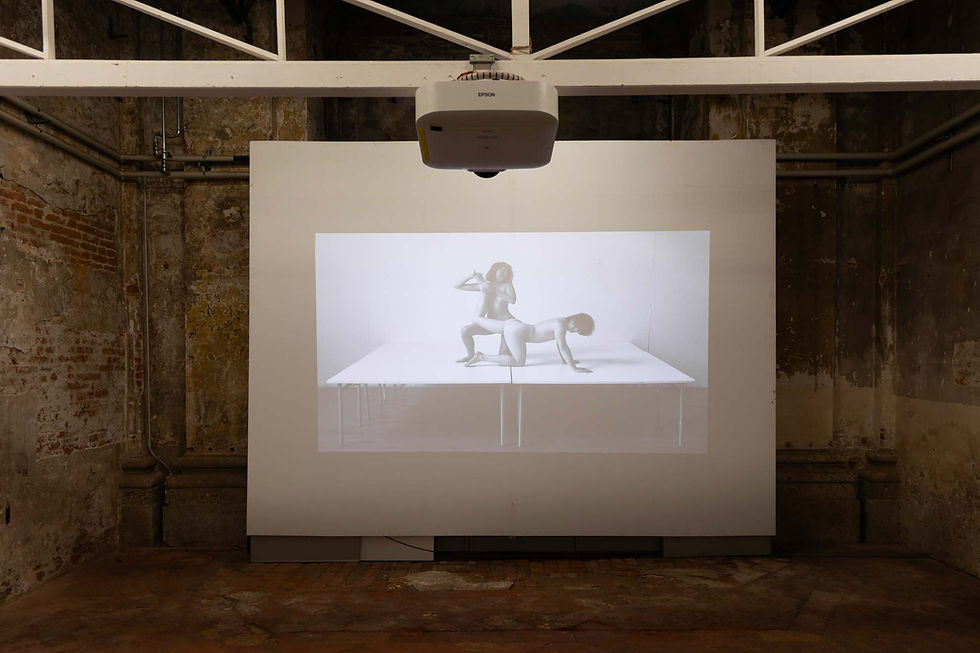
This same temporal dimension is reflected in the practice of the duo VENERDISABATO (Luca Guarino and Sara Lomboni). Who is Friday and who is Saturday? The duality of these two words, at once so close and yet so distant, each of which we associate with precise moments in our daily routines, becomes the key to their work. We are not given the chance to know who is one and who is the other, precisely because nothing clearly separates them. Their work thus slips into the inevitable threshold that each of us crosses every day, suspended in the fluid space between the passage from one state to its opposite.
In this continuous movement between disorientation and recognition, MAGNOLIA reveals the cyclical nature of losing and finding oneself again in the shadow of the Accademia, reminding us that the memory of one’s education is never simply a return to the past, but a living origin. A great curtain of magnolia leaves opens before me, only to close behind me. The magnolia has accompanied the artists along their journey, preserving their traces, experiences, and possibilities, until finally leaving them before a new horizon.
Visitor Information:
Location: Ex chiesa di San Carpoforo (via Marco Formentini, 14 - 20121 Milano)
Dates: September 15 - October 3, 2026
Opening Hours: Monday - Friday: 10:00 AM - 6:30 PM
Saturday: 10:00 AM - 1:00 PM
Sunday: closed


Comments