
Matisse, the Room That Contains the World: A Journey Through Colours and Cultures at MUDEC in Milan
Updated: 16 hours ago
Exotic tapestries, masks, fragrant flowers, and fresh fruit: these were the things Henri Matisse loved to surround himself with. Objects and mementos collected during his travels around the world, which became indispensable companions in his life and work, formed part of an ongoing exploration of new forms and colours.
Curated by Luis Felipe Oviedo Pineda

From October 8, 2026, to February 21, 2027, MUDEC in Milan presents Matisse. Il mondo in una stanza (Matisse. The World in a Room), an exhibition curated by Ellen McBreen and Chiara Gatti, reaffirming the museum’s role as a meeting place for different cultures.
Through approximately one hundred works, including paintings, sculptures, photographs, and works on paper from prestigious national institutions, the exhibition invites visitors to enter the world of the French artist and follow his explorations, encounters, and transformations. A journey through different places, cultures, and visual languages, revealing how what is distant can become a source of inspiration and find new expression through artistic creation.
Matisse: a pictorial atlas of the world
There are rooms that manage to contain the world. Rooms in which objects cease to be mere presences and become traces of distant places, encounters, and desires. It is within a space of this kind that Henri Matisse builds his own universe: among decorated fabrics, masks, floral motifs, and colours that seem to preserve the memory of lands he has travelled through. Everything finds its place alongside everything else, without losing its own identity, as though beauty were born precisely from the possibility of bringing together what is different and distant.
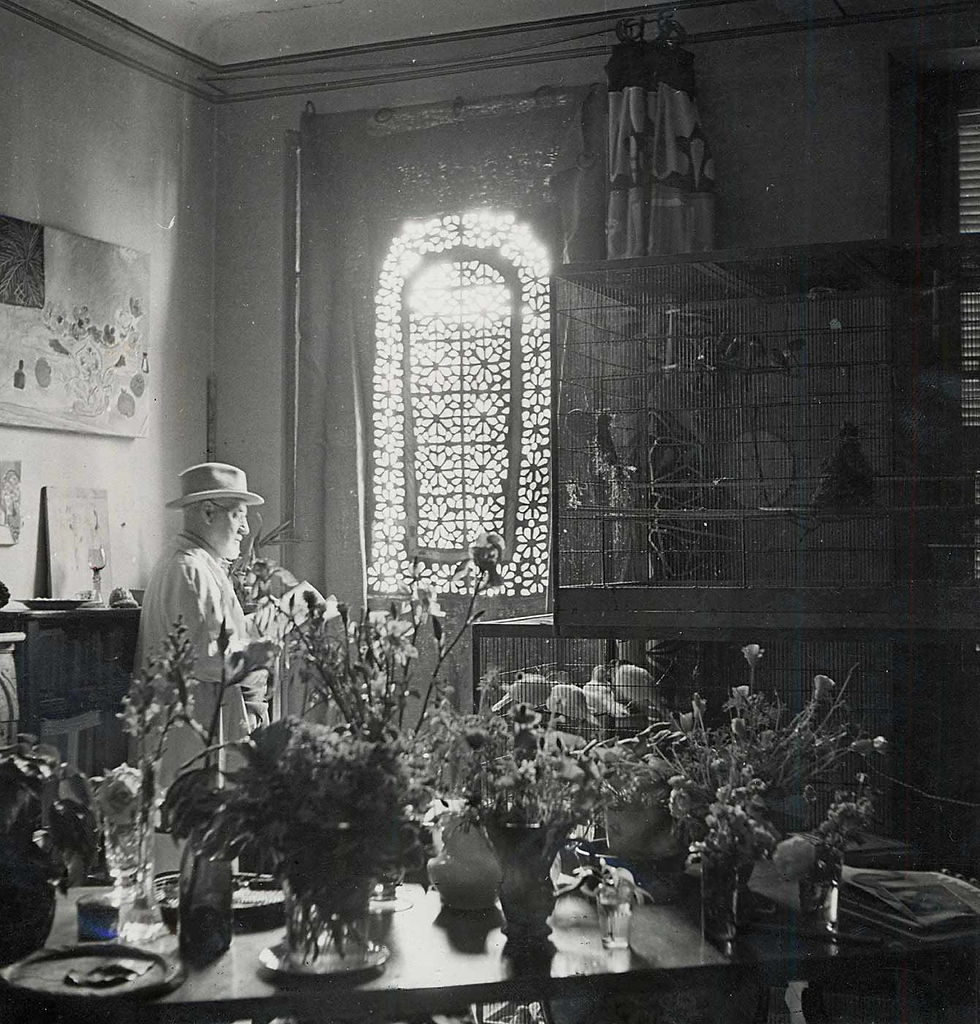
At MUDEC in Milan, the exhibition Matisse. Il mondo in una stanza (Matisse. The World in a Room) invites us to enter this universe and follow its transformations. Arranged into eight sections, the exhibition traces the visual influences that helped shape the artist’s language: from African art to Islamic art, from Russian icons to the evocative imagery of the Pacific. The aim is not simply to retrace the journeys of a curious man, but to observe how each encounter can leave a mark, alter one’s perspective, and open up an unexpected possibility.
Matisse lived in Paris between the late nineteenth and early twentieth centuries, a city swept by artistic ferment and profound change. Yet, as modernity gathered pace, his work seemed to suggest the opposite approach: to pause, observe, and absorb. To let forms speak before words, allow a colour to evoke a sensation, and let a line contain the movement of a body. His artistic research did not advance by isolating itself from the world, but by opening itself up to it, embracing visual languages capable of challenging the conventions of Western tradition.
In 1907, his interest in African masks and sculptural forms opened up new paths in his research. The body lost some of its anatomical accuracy to become synthesis, rhythm, presence. It was no longer necessary to reproduce reality as it appeared: a different kind of truth could be sought, contained in the power of an essential form. Faces and bodies were transformed, moving away from familiar proportions and finding a new balance. The human figure became a space of freedom, where geometry did not impose rigidity but instead conveyed movement. Matisse did not replicate reality; he invented forms.

In 1911, during his trip to Moscow, his encounter with Byzantine art and Russian icons added another dimension to his vision. The pictorial surface opened itself up to a form of spirituality that needed no illusionistic depth to manifest itself. Light was no longer merely what illuminated things: it seemed to emanate from the things themselves, from their silent presence. It was a light that invited viewers to pause, to recognise in the image something that went beyond representation.
Then came Morocco, which Matisse visited in 1912 and 1913. Here, light seems to change in consistency, becoming almost material. Arabesques, decorations, fabrics, and architecture suggest a different way of perceiving space. The line becomes freer, and colour takes on an autonomous quality, capable of evoking an atmosphere without having to describe it. The works from this period seem to preserve the memory of a luminosity that belongs not only to the landscape, but also to the memory of those who have experienced it.

In 1930, his journey to Tahiti once again broadened Matisse’s horizons. The Pacific entered his imagination through forms, rhythms, and evocative impressions that would continue to evolve over time. For him, travelling did not mean collecting views to reproduce faithfully on canvas, but rather allowing a place to settle within him until it became something new. The observed world mingles with the remembered world, and memory, freed from the need to be exact, becomes imagination.
Perhaps this is where one of the secrets of his art lies: in his ability to transform experience into language. His works are not simply records of the places he visited, but spaces in which different cultures and sensibilities enter into dialogue. In his paintings and sculptures, form possesses an almost tactile quality, an immediate visual presence that invites interpretation.
This pursuit of essentiality accompanied Matisse through to the Chapel of the Rosary in Vence, one of his last major projects. There, through pure line, drawing, and the relationship between light, colour, and space, the artist took his desire to reduce forms to their essence to its ultimate expression. After a lifetime spent welcoming the world in its many forms, Matisse seems to seek a beauty capable of expressing itself through a symbolic formal minimalism.
And so, Matisse’s “room” ceases to be merely the place where he worked, becoming a metaphor for our own way of being in the world. We, too, are made up of encounters, images, words, and memories gathered along the way. We carry within us fragments of places and unfamiliar gestures that have taught us something, shaping an identity in constant transformation.
In a time that urges us to rush, consume images, and move quickly from one experience to another, Matisse reminds us of the value of slowness and taking a moment to pause. Truly looking requires time and openness: the ability to approach unfamiliar things, accepting that the encounter with them may transform us.
Perhaps this is precisely the world that Matisse preserves in his room: not a refuge from the outside world, but a window wide open onto it. A place where differences coexist, where each form retains its own voice and, together with the others, contributes to a new harmony. Because beauty often arises not from finding what resembles us, but from learning to recognise what is distant. And discovering, within that space, a part of ourselves.

The exhibition is produced by 24 ORE Cultura – Gruppo Il Sole 24 ORE and promoted by the Municipality of Milan’s Department of Culture. It is organised in collaboration with the Musée Matisse in Nice, with Unipol as Main Sponsor and support from sponsors Turisanda1924, the travel brand of Alpitour World, Enel, and BPER Banca.
Visitor Information
Location: MUDEC Milano (via Tortona 56, Milano)
Dates: October 8, 2026 - February 21, 2027
Opening Hours: Monday: 2:30 PM - 7:30 PM
Tuesday, Wednesday, Friday, Sunday: 9:30 AM - 7:30 PM
Thursday, Saturday: 9:30 AM - 10:30 PM


Comments